

By: Paige Sutter, LPC
March 2021
I was sitting at our makeshift home office in the kitchen, staring at the man in a button-up shirt on the computer screen in front of me. My heart was pounding, and my hands gripped the edges of my chair to keep my hands from shaking. I caught myself beginning to roll my chair nervously around the tile and crossed my legs yet again. Sitting next to me my husband, Branson, exchanged pleasantries, and his voice sounded unnaturally loud in my ears. I wondered how the man I was looking at on the screen managed to keep so calm as he prepared to talk about human brains and life-altering decisions. He introduced himself, said that he had reviewed my MRI, and would like to go over the results with us. He might as well have been introducing the weather report he was going to give. All of these thoughts took maybe ten seconds to race through my mind, but to me it felt like an eternity.
Even the morning leading up to this moment had felt long and dreamlike. I woke with a strange sense of relief and dread all mixed together as I finally reached the day in which I was almost certain I would get bad news. People can quote “hindsight is 20/20” all they want, but for months I had harbored a strange feeling in my gut that there was something not quite right in my body. The night before I told my husband that my greatest fear was to hear yet another “I don’t know” and to be stuck in a never ending loop of uncertainty. As I brushed my teeth and got ready for the day I prayed for an answer, any answer, as long as it had a solution.
I floated through my therapy sessions that day, catching the important snippets in between thoughts like “What if it’s cancer?” “How long will I have to live?” “What if he thinks I’m making the whole thing up?” As I was working with children on coping skills, thought stopping, and mindfulness, I was fighting a war with my own thoughts that no one else could see. Branson later told me that he was having a similar battle that morning, with a very tense meeting as a result. He was actually in one of these meetings up until the very moment my neurologist checked in, which led to a frantic scramble as I called and he flew into the room. I don’t know what we thought would happen if he was not there at the exact moment the appointment started, but the answer was that the doctor would wait patiently for his arrival from the next room. When in doubt, schedule a morning appointment. Your clients and coworkers will thank you.
“I found a lesion on your brain around your temporal lobe.” he stated, motioning around his left ear and snapping me out of my reverie. “There are a few different possibilities, but it is most likely some type of tumor.” I heard my husband’s sharp intake of breath as my world shrank to the size of a pinhole. I could almost see the little men running around inside my head, running into each other as they raced to flip off all the switches. For the next ten minutes or so I continued to stare at the man with the white hair and the monotone voice, which was now the only voice in existence, as he discussed symptoms, possible diagnoses, and warning signs. I could feel my husband’s hand in mine and heard words such as “meningioma,” “neurosurgeon,” and “seizures” float by. I vaguely heard my husband ask several questions, and it occurred to me at some point that this was my brain we were talking about; I should probably have a question too. I racked my mind trying to think of something intelligent to say, and all I could come up with was crickets. I eventually asked something, but I have no idea what it was and can’t imagine that it helped us any.
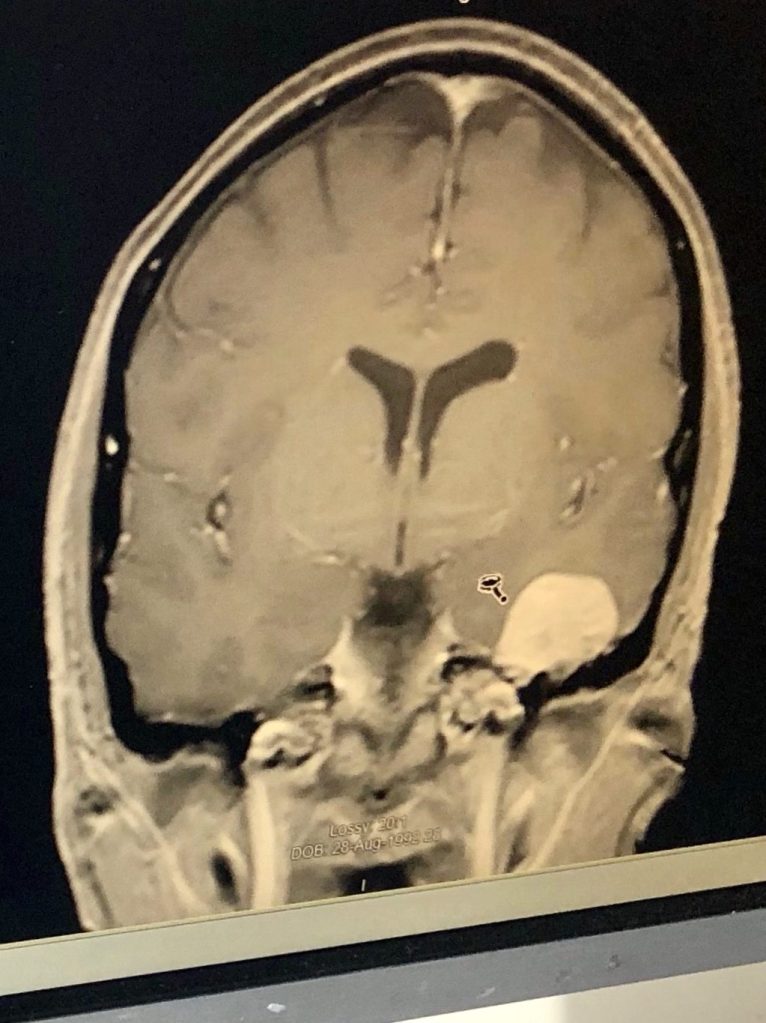
Although I did not take in much information at the time, with the help of Branson and the recording we made we were able to later piece together the nuts and bolts of the conversation. Dr. Oberlander believed that I had either a meningioma or a schwannoma around the back of my ear, and my brain was essentially sitting on top of the tumor. He said that symptoms could include headaches, stumbling, dropping things, blurred vision, and mood changes, all of which I was experiencing to some extent. He also said that seizures were a possibility and provided a prescription to prevent this. Overall, I was impressed with the way he handled all of our questions and gave us the diagnosis in a matter-of-fact way. He also provided us with his personal number in case we had any more questions. He ended the telehealth appointment by saying, “I am referring you to a neurosurgeon who is very skilled in this area and will be able to give you a better understanding of what is going on. His name is Dr. Krisht and I expect you will be seeing him in the next few weeks.” Little did I know that this referral could very well have saved my life.
 Finding Grace Counseling and Wellness, LLC